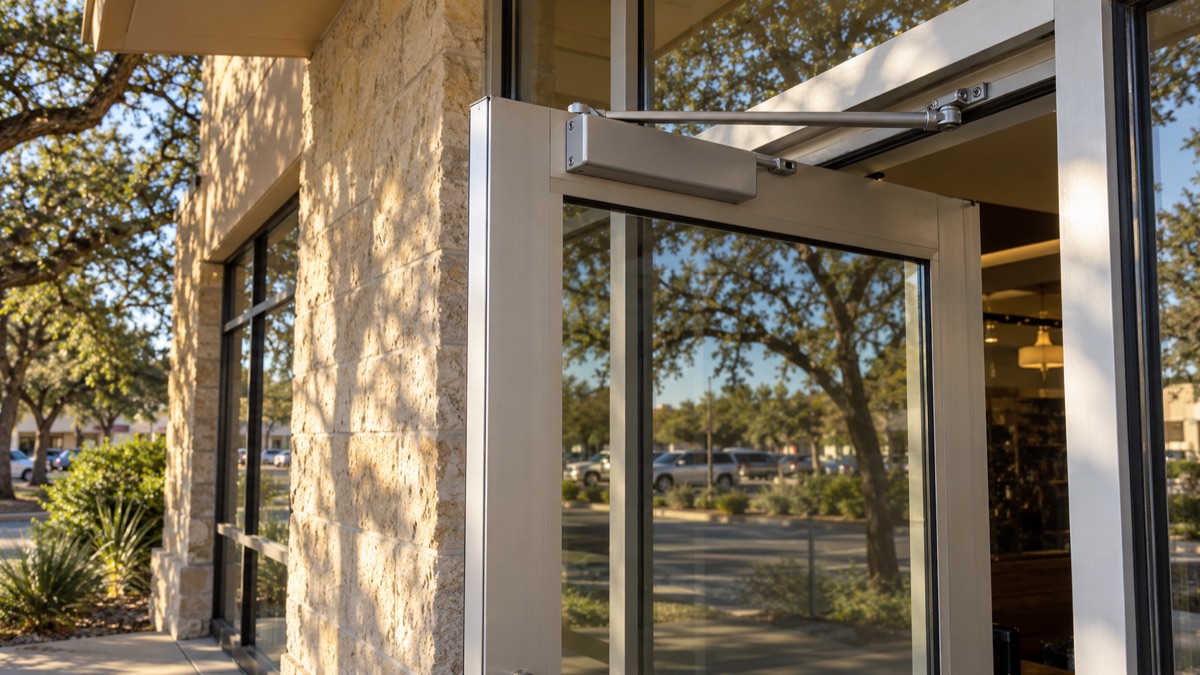

A storefront door that slams, will not latch, drags on the floor or has a sticky exit bar is almost always one of three things: a setting that needs a small adjustment, a worn part that needs repair, or a device that needs replacing. Closer problems are often the easy kind. Exit-device and latch problems are life-safety hardware, and they belong to a technician.
This guide is for owners of Austin businesses, from a South Congress boutique to a Domain restaurant to a strip-center office. It sorts the symptoms, explains what each part does, and says plainly where the rules apply. For the full range of business door work, see our commercial locksmith services.
Is your storefront door problem an adjustment, a repair or a replacement?
Most door complaints sort into three groups. A door that slams or closes too slowly is usually a closer speed setting. A door that drags, sags or misses the latch often points to alignment or worn hardware. An exit bar that sticks or will not retract is a repair or replacement job for a technician. The table below sorts the common symptoms.
| Symptom | Usual cause | What to try first | When to call |
|---|---|---|---|
| Door slams shut | Closer speed set too fast | Make one small valve turn, using the maker's sheet | If the door still slams after a small change |
| Door closes too slowly | Speed set too slow, or a weak closer | Check that nothing rubs or blocks the door | If a speed change does not help |
| Door will not latch | Sag, shifted frame, loose strike or closer | Look at the gap and the strike line | If the bolt still misses the strike |
| Door drags or sags | Worn pivots or hinges | Check for loose screws | Right away, since sag keeps getting worse |
| Exit bar sticks | Worn or misadjusted exit device | Nothing to try at home | Right away, it is life-safety hardware |
| Deadlatch bolt does not catch | Fit problem before a lock problem | Check alignment and the closer | If it still will not secure at night |
Each of those rows has its own section below. Our door closer service covers the speed and spring side, our panic bar service covers exit devices, and our storefront lock service covers the narrow aluminum doors you see on most retail fronts.
What does a door closer actually control?
A hydraulic closer controls three things: how hard the spring pulls the door shut, how fast the door swings through the main part of its travel, and how fast it moves through the final latching stretch. Many also have a backcheck that cushions the door when it is thrown open. Spring power, speed valves and backcheck are separate adjustments.
That separation matters, because a door that slams and a door that will not latch can look alike from across the room. One is usually a speed problem. The other can be a spring, a speed or a fit problem. Knowing which part of the swing is wrong tells you which adjustment to look at.
The industry writes down how closers should perform. The BHMA closer standard covers closers that mount on the surface, hide in the door or sit in the floor, and its top grade must pass a test of two million cycles of opening and closing. That is a lab figure on a test door. BHMA itself says field results differ because of installation, door and frame construction, maintenance and environmental conditions.
One manufacturer’s instruction sheet numbers its regulating valves: backcheck, main speed and latch speed. Other makers may label theirs differently, so read the sheet for your own closer, not a general guide.
How fast should a storefront door close?
Under the ADA 2010 Standards, a closer is adjusted so the door takes at least 5 seconds to travel from 90 degrees open to a point 12 degrees from the latch. One manufacturer instruction sheet calls 5 to 7 seconds from 90 degrees to closed a normal total, split about evenly between main speed and latch speed.
Those are two different clocks, and they should not be merged. The ADA clock stops at 12 degrees from the latch. The manufacturer’s clock runs all the way to closed. Neither number replaces the other, which is why the diagram below draws them as separate bars.
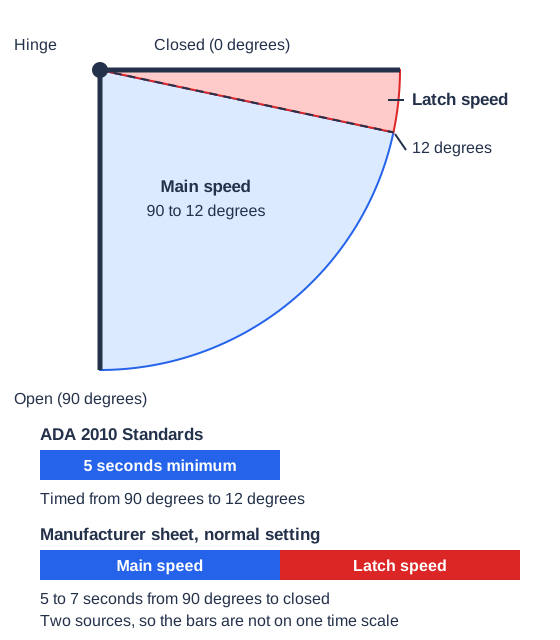
Five seconds from 90 degrees to 12 degrees is the minimum, not the target. A door set faster than that can fail the standard, and a door set far slower can be a nuisance on a busy afternoon. The 2010 Standards also treat the force to open a door separately. Their 5 pound limit applies to interior hinged doors, not to an exterior storefront door, and fire doors follow the minimum allowed by the local authority.
You can read the door-closer rule yourself in the Access Board’s guide to entrances, doors and gates, and the full text of the 2010 ADA Standards is on ada.gov. We cannot tell you your door passes without timing it. We can tell you what the clock is supposed to measure.
How do you adjust a door closer safely?
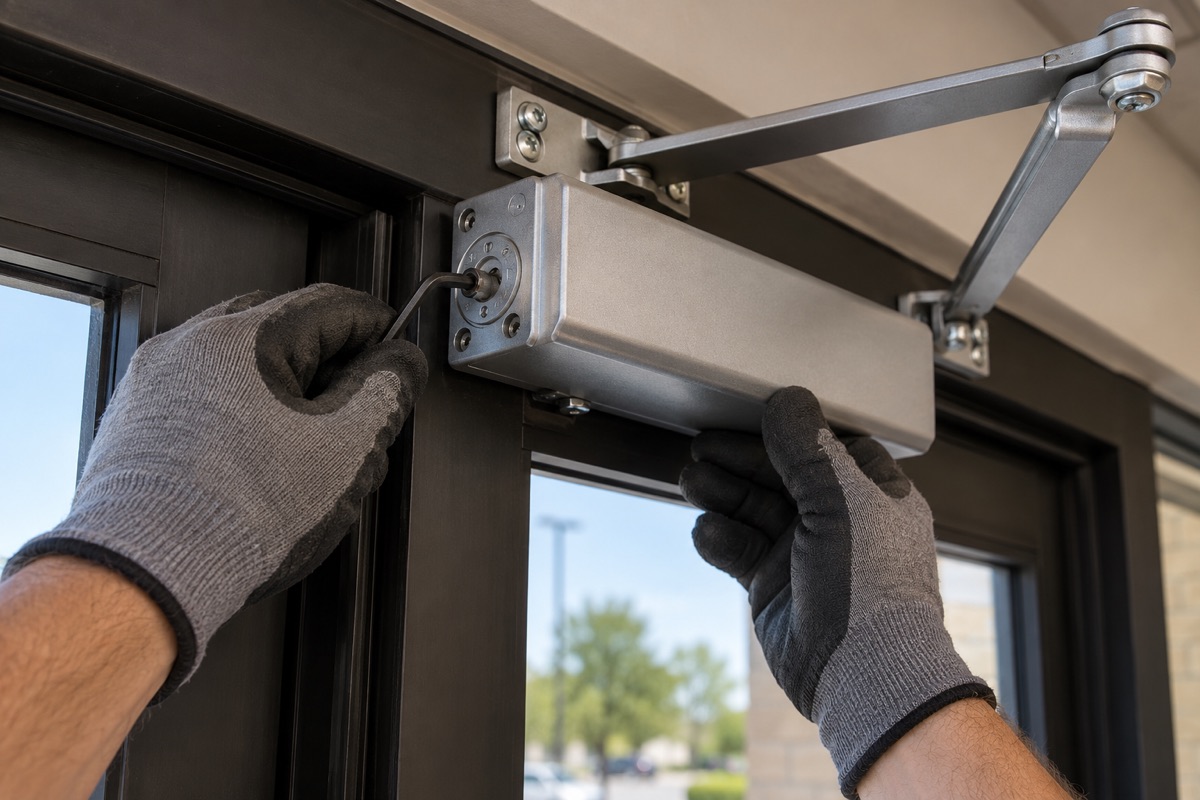
Adjust one setting at a time, in small turns, with the door and frame checked first. Confirm the door is not binding and the closer is mounted tight, set spring power only if the door will not close at all, then trim main speed, then latch speed, then backcheck. Time the door with a watch, and stop if fluid appears.
Treat that order as general guidance, not a promise about your closer. Valve labels, turn direction and the tool you need differ between makers, so follow the instruction sheet for your model. A quarter turn at a time is a sensible habit, not a sourced figure, and we are not giving hex key sizes for the same reason.
Adjusting a door closer, one change at a time
-
Step 1: Check the door and mounting
Make sure nothing rubs, and that the closer screws are tight.
-
Step 2: Watch a full close
Note which part is wrong: the swing, the middle or the last stretch.
-
Step 3: Turn the matching valve a little
Change one valve, by a small amount, and only one at a time.
-
Step 4: Time the sweep
Time 90 degrees to 12 degrees and confirm the 5 second minimum.
-
Step 5: Recheck the latch and backcheck
Confirm the door latches, then set the backcheck last.
Opening a valve too far is the most common way a small adjustment turns into a replacement. If you cannot find the instruction sheet, or you are on a ladder reaching over a glass door, that is a good moment to hand the job over.
When is a closer past adjusting?
A closer that no longer holds a setting, leaks fluid, has a bent arm or pulls out of its mounting is past adjusting and needs repair or replacement. A door that still will not latch after the closer is dialed in points to the door, frame or latch, not the closer. Replacing a worn closer is usually simpler than chasing it.
A busy door cycles often, and a door that cycles often wears faster. That is plain reasoning, not a statistic, and we have no sourced lifespan to give you. What you can watch is behavior: a closer that needed a tweak last month and needs one again is telling you something.
If you are weighing repair against replacement across a whole building, our guide to rekeying or replacing locks lays out the same decision for residential locks, and the thinking carries over. For the closers themselves, start with our door closer page.
What does a panic bar do, and which doors need one?
Panic hardware lets people leave through a door with one push, even in a crowd. Under the model building code, swinging doors serving an assembly or educational space with an occupant load of 50 or more, and doors serving high-hazard rooms, need panic hardware or fire exit hardware. Austin has adopted the 2024 IBC and IFC, so ask the City which section applies to your door.
Two terms come up here. Panic hardware is the push bar or touch pad that retracts the latch. Fire exit hardware is panic hardware that has also been tested for use on a fire-rated door. Panic hardware is listed to UL 305, and fire exit hardware is listed to UL 10C and UL 305. People often say “exit device” or “panic bar” for either.
The City of Austin’s building technical codes page lists the 2024 International Building Code and the 2024 International Fire Code, with local amendments, under an effective date of July 10, 2025. The occupancy thresholds above come from the 2021 IBC numbering. We have not read the 2024 text, and we do not know Austin’s local amendments, so treat the thresholds as the model code, not a ruling on your door.
One industry standard, BHMA A156.3, covers exit devices. Its top grade is tested through 500,000 loaded cycles, and it requires the latch bolt to withstand a 400 pound load in the direction of exit without the door swinging open. That is a lab test of the product. It says nothing about whether your door is correct for your occupancy. Our panic bar installation page describes how we match hardware to the door.
How can you tell a panic bar needs adjustment or repair?
Warning signs are a bar that sticks halfway, a latch that does not fully retract, a door that bounces off the strike without latching, loose mounting screws, or a bar that needs a hard shove. The code ceiling for unlatching force is 15 pounds, and a bar that feels stiffer than that needs attention before the next busy day.
That 15 pound figure comes from the 2021 IBC numbering, which also says the releasing part of the bar must span at least half the width of the door leaf. Operable parts of door hardware sit between 34 and 48 inches above the floor. The ADA says the same about height and adds that hardware must work without tight grasping, pinching or twisting of the wrist.
You do not need a scale to know something is wrong. If the bar feels stiff, drags, or does not spring back, call. Egress hardware is not a place to experiment, and a bar that fails on a quiet Tuesday will not get better on a busy Saturday. Our panic bar service covers adjustment, repair and replacement.
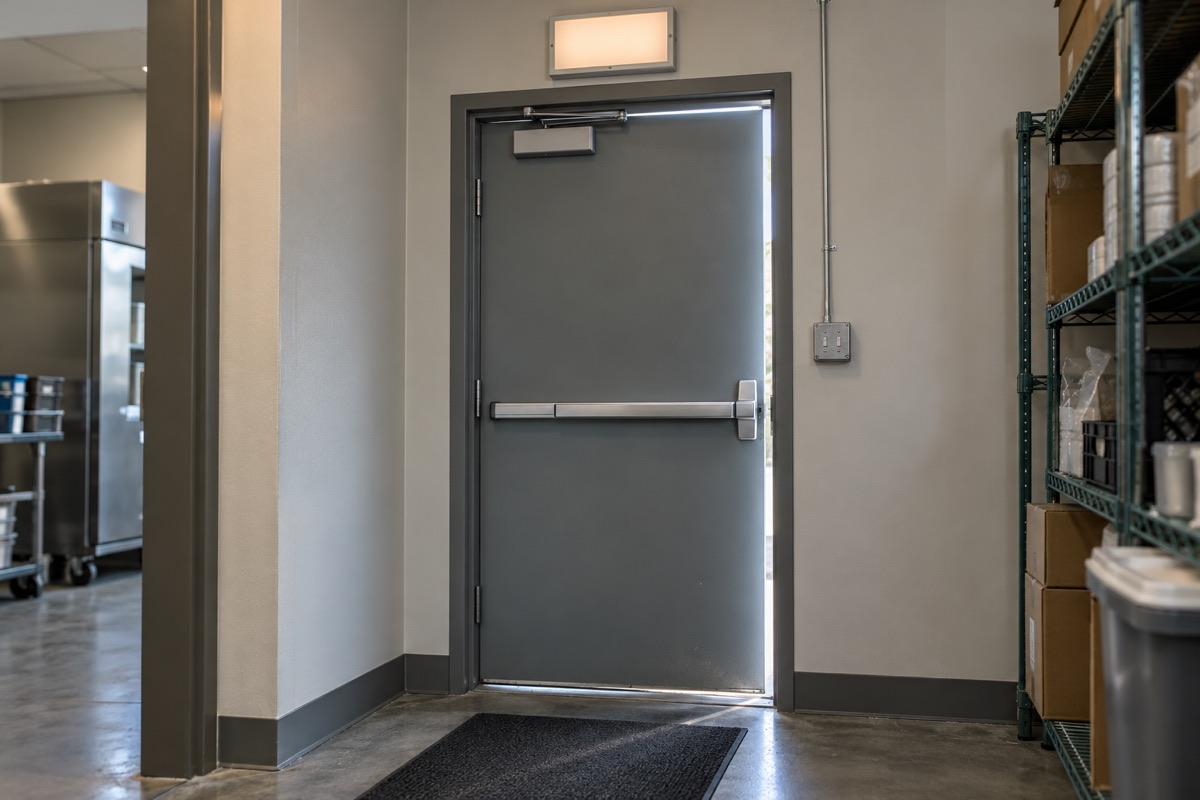
What should never be done to an exit door?
Never chain, padlock, screw shut or block an exit door during business hours, and never add a second lock that needs a key or extra steps to leave. The code requires one motion to release every latch and lock on an egress door, so anything that adds a step is a violation and a hazard.
Releasing a door for egress takes one motion, and that motion releases every latch and lock. The model code words it as no more than one motion in a single linear or rotational direction, with narrow exceptions such as places of detention. For the qualifying assembly, educational and high-hazard doors, it also says the door shall not have a latch or lock other than panic hardware or fire exit hardware.
The risk is not theoretical for a small shop. A back door chained against theft, a barrel bolt added after a break-in and a stockroom door blocked by delivery boxes are common ways a business ends up with a blocked exit. If theft is the worry, there are ways to secure a door without adding a step to the way out, and our security hardware page is the place to start.
What does a storefront deadlatch do?
A storefront deadlatch is the narrow lock built into the edge of an aluminum glass door. When the door closes, the bolt extends and a deadlatching feature keeps it from being pushed back, and a key or thumbturn locks it. Because the stile is narrow, the lock and the door’s alignment have to be right for it to catch.
Our storefront lock page describes the aluminum frame, or stile, as typically only a few inches wide, far narrower than a standard door. That is why these doors use slim mortise locks, with the bolt reaching into the frame. A hook bolt is a curved bolt that catches behind the strike, and some storefronts use one for extra resistance to prying.
Here is where this post stops. We have not cited a standard for the deadlatch itself, and we are not naming a product family or a grade for it. What we can say is what our service page says: the lock is only as good as the fit around it, and misalignment is a common reason the bolt misses.
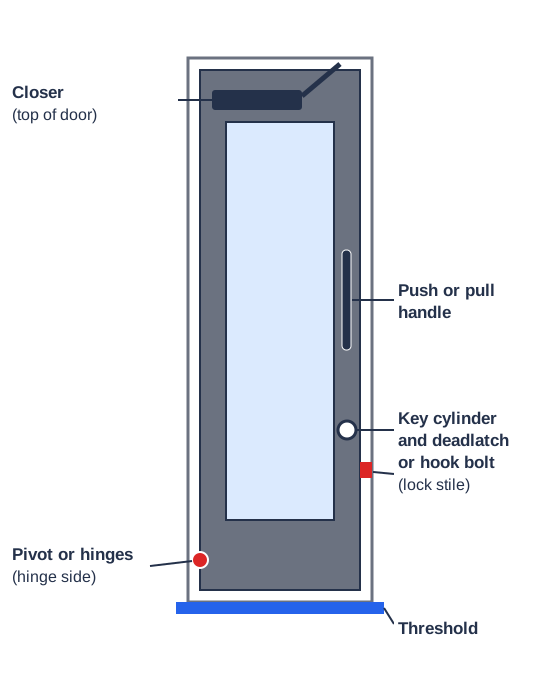
For the home-front-door counterpart, our guide to high-security locks for Austin homes explains how residential lock grades work. For the storefront side, see our storefront lock service.
Why do aluminum storefront doors stop latching?
When a storefront door stops latching, the lock is often fine and the fit has moved. A sagging door, worn pivots or hinges, a shifted frame, a loose strike or a closer that no longer pulls the door fully shut can all keep the bolt from reaching the strike. Check the gap and the strike line before replacing the lock.
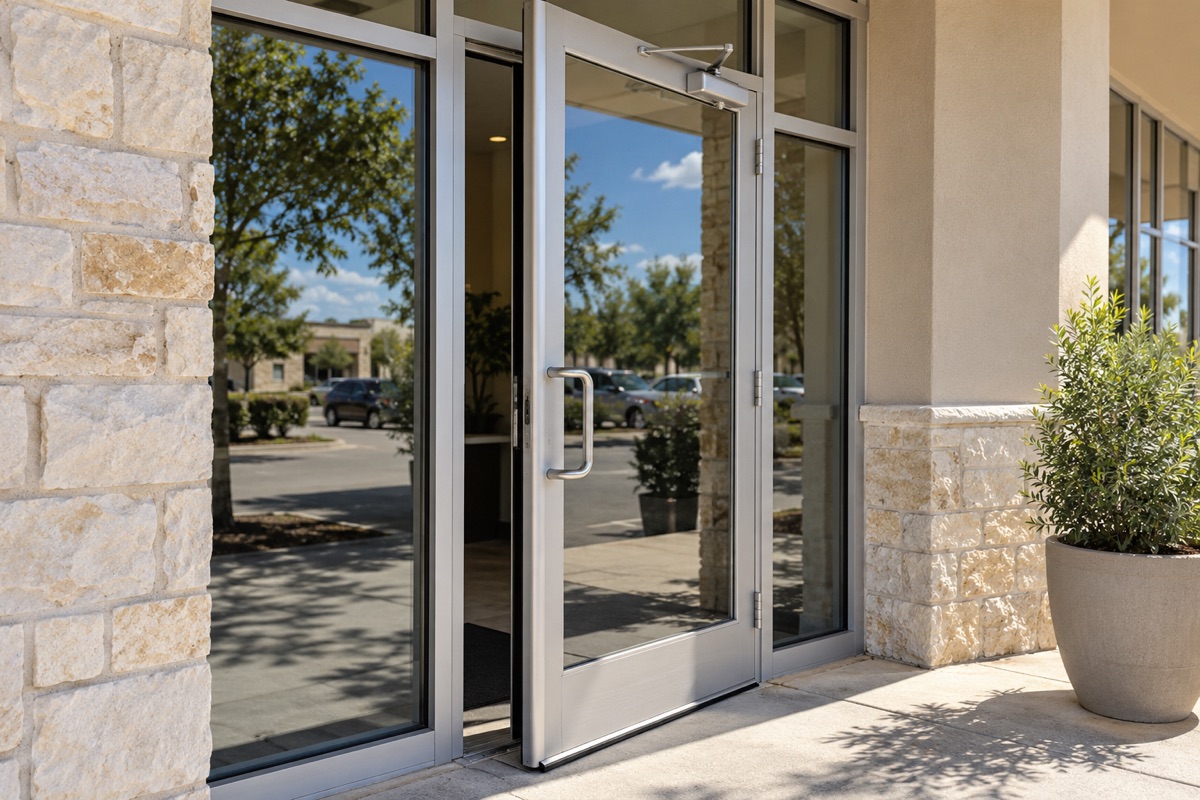
Glass storefront doors on South Congress, at the Domain, on East Sixth and around Rainey Street take heavy daily use. Event weekends such as SXSW, ACL and UT home games push far more foot traffic through the same doors, so a closer and an exit device cycle more often than they do in a quiet month.
Walk the problem in order. Look at the gap between the door and the frame, all the way around. Look at where the bolt lands against the strike. Watch whether the closer pulls the door the last inch. A bolt that lands low or high points at sag. A door that stops short points at the closer.
Be honest about the limit, too. When the door or the glass itself is out of square, a door and glazing vendor is the right call, and a locksmith can only fix the hardware side. We would rather tell you that on the phone than after a visit. Our storefront lock page and our wider commercial services cover what we can do.
Can you fix it yourself, or do you need a licensed technician?
You can check for loose screws, an obstructed door and a closer that is simply set too fast, and make a small valve turn. Anything involving an exit device, a deadlatch, a door that will not secure at night or a closer that is leaking should go to a licensed technician. Ours is licensed under Texas DPS B30821501.
That licence is the one thing to verify before anyone works on your door, and you can check any locksmith’s licence yourself. Our guide to fake locksmith scams in Austin lists the warning signs to look for before you hire anyone.
Pricing depends on the door and the hardware. The estimate is confirmed on site before work starts, and our pricing page shows the published ranges. This guide does not quote prices for closers, exit devices or storefront locks, because we would rather you hear the number for your own door.
To talk through your door, call (737) 222-7022 or use our contact page. Tell us which symptom from the table fits, and what the door looks like when it fails. A clear description gets you a clearer answer.
Where do keys, keypads and electric strikes fit in?
Closers, exit devices and deadlatches control how the door closes, latches and releases. Keys, keypads and card readers control who may unlock it. They work together: an electric strike, for example, lets an authorized person in without changing how people leave. Keep the two questions separate when you plan a door.
An electric strike is one way to add controlled entry to a door that already has good closing hardware. If the question is keys across many doors, our commercial rekeying service and our guide to master key systems cover key control. For readers, credentials and cost, see our guide to access control for small businesses.
Our security hardware page pulls these together. And if you are also looking at your own front door at home, our guide to the signs it is time to upgrade your home security is a short companion read.
Frequently asked questions
How long should a storefront door take to close?
The ADA 2010 Standards set a 5 second minimum for the door to travel from 90 degrees open to 12 degrees from the latch. One manufacturer instruction sheet calls 5 to 7 seconds from 90 degrees to fully closed a normal total, split about evenly between main speed and latch speed.
Does a business have to have panic bars?
It depends on the occupancy and the occupant load. Under the model building code, swinging doors serving assembly or educational spaces with an occupant load of 50 or more, and doors serving high-hazard rooms, need panic hardware or fire exit hardware. Austin has adopted the 2024 IBC and IFC, so confirm your door with the City or the fire marshal.
How hard should an exit bar be to push?
The model building code limits the unlatching force of panic hardware to 15 pounds (2021 IBC numbering). If your bar feels stiffer than that, or sticks partway, it needs attention from a technician before the next busy day.
Can I adjust a door closer myself?
Small valve turns are within reach if you follow the maker’s instruction sheet for your closer. Do not open a valve too far, because one manufacturer warns it can cause leakage, injury or property damage. Stop if any fluid appears, and call a technician.
My storefront door will not lock at night. Is it the lock or the door?
Often it is the door. A sagging door, worn pivots, a shifted frame, a loose strike or a closer that no longer pulls the door fully shut can all keep the bolt from reaching the strike. Check the gap and the strike line first, then call if the bolt still misses.
Next step: start with the door, then call
Start with the five checks in this guide: the closer speed, the latch fit, the exit bar, the deadlatch and the door itself. If one of them points to hardware, call Austin Locksmiths at (737) 222-7022. We can talk it through first, with no promises about arrival times, just an honest read of what you describe.
Read more about our door closer service, panic bar service and storefront lock service, or send us a note through the contact page.
Prices shown are estimates
They give you a general idea of what the service costs, and are not a final quote. Your actual price depends on the lock, the vehicle or door, job complexity, and time of day. Your technician confirms the exact final price with you on site, before any work begins.