
A deadbolt install is mostly door work. Before the bolt goes in, the door needs a 2-1/8 inch hole through the face, a 1 inch hole in the edge, the right backset and a thickness the hardware can handle. Our published estimate for deadbolt installation in Austin is $120-225, includes hardware, and is confirmed on site before work begins.
This guide walks through the checks in the order they happen. You will see what the technician looks at, why each check matters and why the final number can move. It is written for Austin homeowners who want to understand the job before they call.
How much does deadbolt installation cost in Austin?
Our published estimate for deadbolt installation is $120-225, and the pricing page notes that it includes hardware. It is an estimate: the technician confirms the exact final price on site before any work begins. No trip charge applies, and service between 10 PM and 7 AM adds a $25 after-hours fee.
Why confirm on site? Because the number depends on the door, and the door has to be checked first.
Two other jobs get mixed up with this one. A lock change or replacement has its own estimate of $90-200, covered on our lock change and replacement page. Rekeying is priced per lock, with an estimate of $30-60, and we explain it in what a rekey costs per lock. You can see all of it on our published price estimates. Every figure there is an estimate, and each one is confirmed on site.
What does the installer check on your door first?
The installer checks four things first: the holes already in the door, the backset, the door thickness, and the frame where the bolt lands. The install sheet for a common residential deadbolt starts with a check of door preparation and says that if the dimensions do not match, you may need to modify your door. Each check decides whether the lock fits as is.
Here is how the checks line up. The sizes come from the maker install sheets for common residential deadbolts. Your model may differ, so the sheet for the exact lock wins.
| Check | What the maker sheets say | Why it matters |
|---|---|---|
| Cross bore (face hole) | 2-1/8 inch (54 mm); some doors already have 1-1/2 inch | Holds the lock body; a mismatch means modifying the door |
| Edge bore | 1 inch (25 mm) | Holds the bolt latch and must meet the face bore |
| Backset | 2-3/8 or 2-3/4 inches | Sets where the lock sits and which latch length fits |
| Door thickness | About 1-3/8 to 1-3/4 inches for most standard models | Outside the range, a different model or service kit is needed |
| Strike hole in the frame | At least 1 inch (Kwikset) to 1-1/4 inches (Schlage) deep | Lets the bolt extend fully without dragging |
The order matters. The holes tell you what the door has already been through. The thickness tells you which hardware is even an option. The frame tells you whether the bolt has something solid to land in.
That is worth saying plainly. A deadbolt is only as sound as the door and frame it is fitted to. The Builders Hardware Manufacturers Association says in its residential deadbolt standard that results in the field vary with installation and with door and frame construction. A good lock on a weak door still sits on a weak door.
What size holes does a standard deadbolt need?
A standard residential deadbolt needs a 2-1/8 inch (54 mm) cross bore through the face of the door and a 1 inch (25 mm) edge bore for the bolt. Schlage and Kwikset sheets agree on both sizes. Some doors are already drilled with a 1-1/2 inch cross bore, which Kwikset’s drilling instructions handle with a separate set of steps.
The diagram below puts every number in one place. It shows the two bores, the two common backsets and the thickness range. It also shows the strike hole in the frame, which we come back to later.
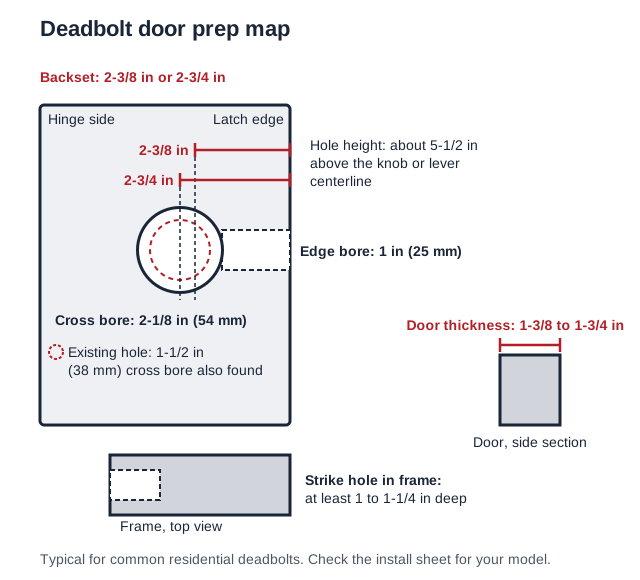
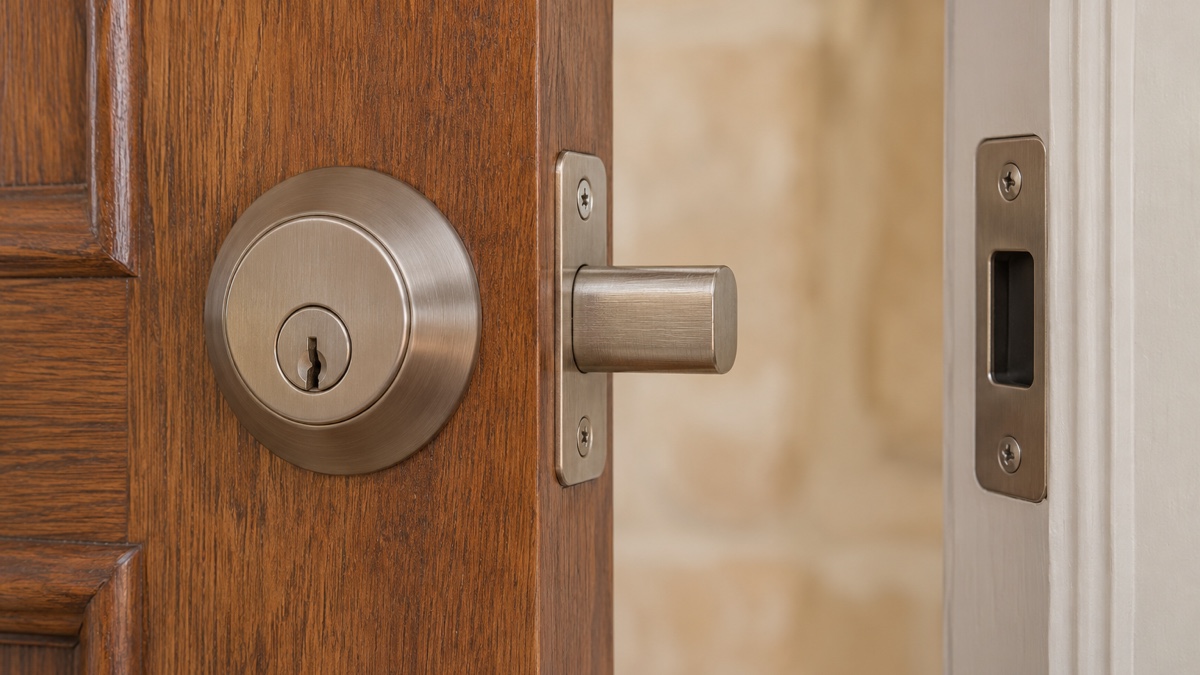
Why two holes? The face bore holds the lock body. The edge bore holds the bolt latch. The two have to meet inside the door, which is why a small error in either one shows up as a lock that binds.
The maker sets the hole height too. The template position sits about 5-1/2 inches above the centerline of the knob or lever. You can read the full dimensions yourself in the Schlage B60 and B62 install sheet.
We work across the Austin area, from West Lake Hills (78746) and Mueller to Tarrytown and Pflugerville. The sizes above do not change with the zip code. What changes is the door in front of us, which is the next check.
What are backset and door thickness, and how do you measure them?
Backset is the distance from the edge of the door to the center of the cross bore, and common deadbolts fit either 2-3/8 or 2-3/4 inches. Door thickness matters too. Most standard deadbolts are made for doors about 1-3/8 to 1-3/4 inches thick, so check the sheet for your exact model before you buy hardware.
To measure backset, run a tape from the edge of the door to the center of the existing hole. You will land close to one of the two numbers. If you are shopping for a new lock, one Schlage product page lists a universal backset that adjusts to 2-3/8 or 2-3/4 inches. Read the sheet for the model before you assume.
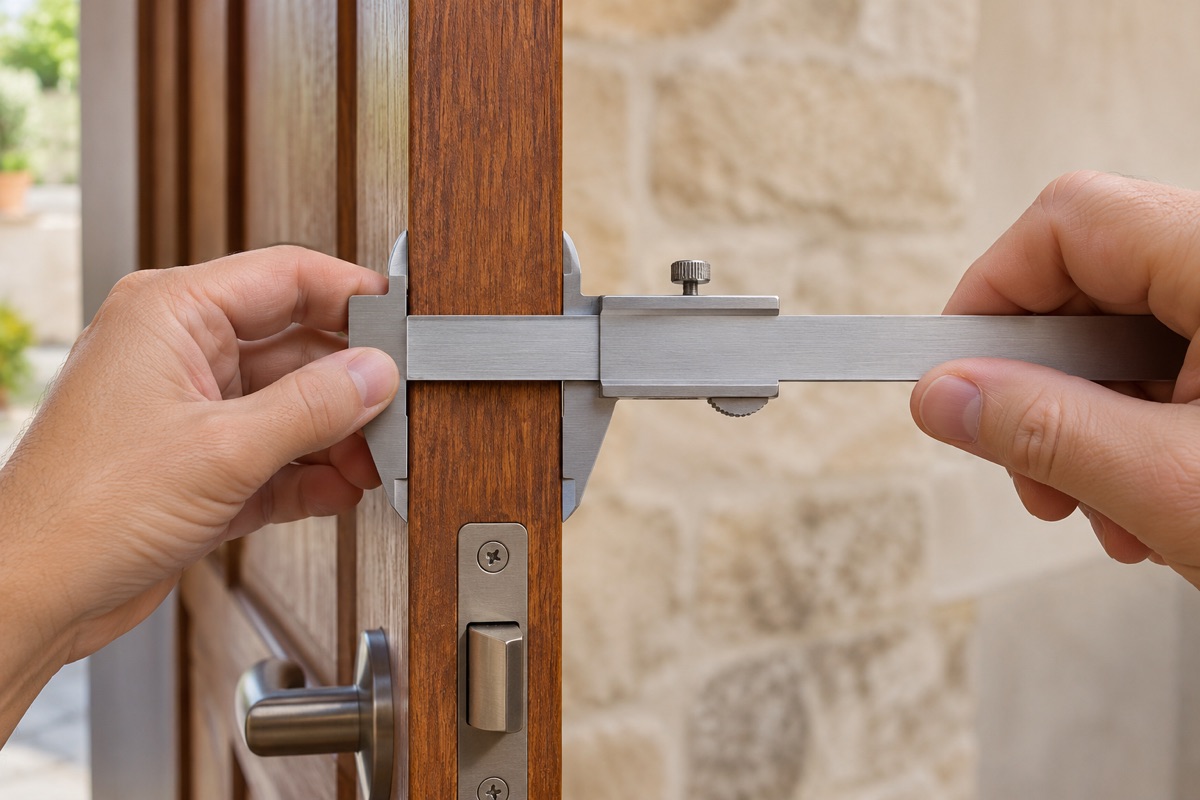
To measure thickness, look at the edge of the door with the door open. A tape or a caliper across the edge gives you the number. A caliper is more exact, but a tape is close enough to tell you which range you are in.
What if the door is too thick or too thin? That is a conversation about a service kit or a different model. It is never a case of forcing the hardware to fit. Kwikset, for one, notes a service kit for doors 2-1/4 inches thick. Other models have their own limits, so the sheet for the exact lock is the final word.
What if the door is already drilled, or the sizes do not match?
Start with what is already there. If the door has a 1-1/2 inch cross bore, Kwikset’s drilling instructions give separate steps for it. If the sizes do not match the sheet, the Schlage sheet says you may need to modify your door. That work is part of the on-site check, and the technician confirms the price after seeing the door.
Kwikset’s drilling instructions describe the method. Drill from one side until the point of the bit just breaks through, then finish the hole from the other side. That keeps the wood from splintering around the hole.
Templates matter too. Kwikset’s printable drilling template has to be printed at 100 percent exact size, or the hole lands in the wrong place. You can read its steps in the Kwikset deadbolt drilling instructions.
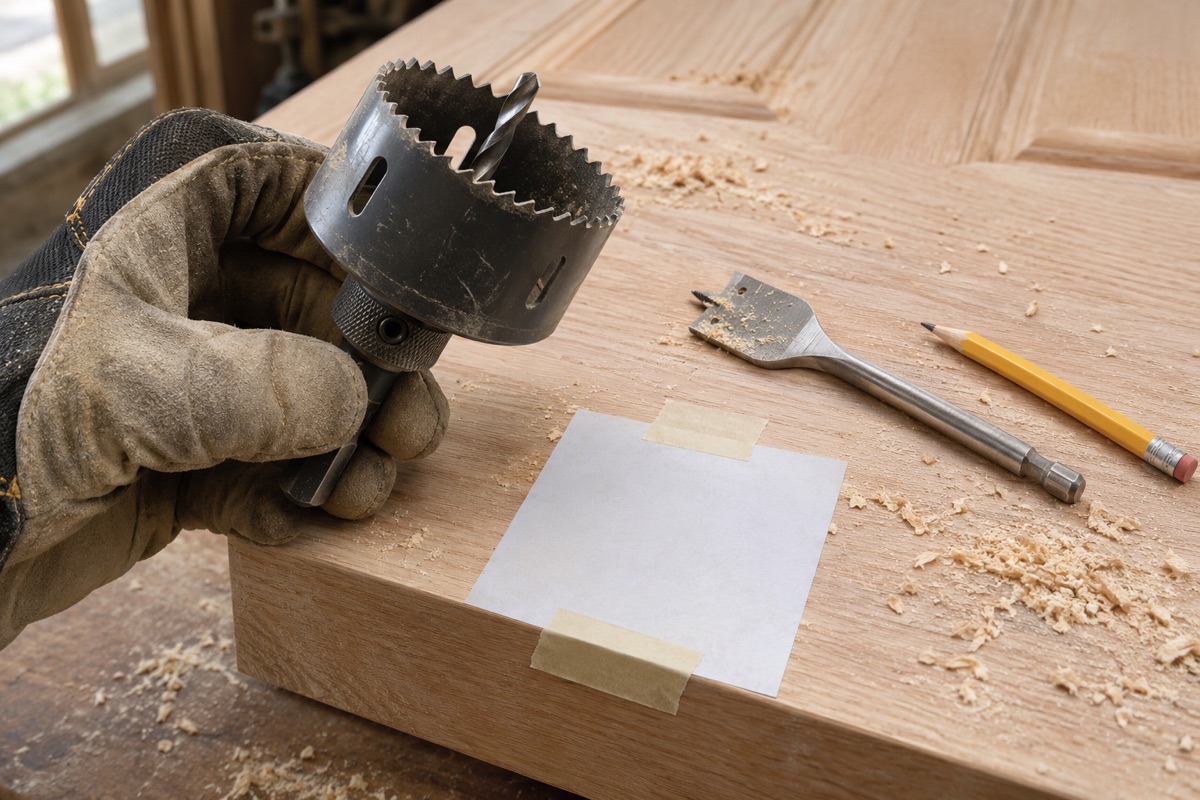
Part of the on-site check is choosing hardware that suits the door you have.
What happens during a deadbolt installation, step by step?
The sequence follows the maker sheets: check the door preparation, mark and drill the face hole and edge hole, fit the latch and the lock body, install the strike in the frame, then test that the bolt extends fully. Before any drilling starts, the technician confirms the final price with you on site.
The grid below puts the six steps in order. The steps follow the maker sheets and support pages, and none of them has a timer on it. A careful install runs at the speed the door allows.
A deadbolt install, in the order it happens
-
Step 1: Check the door
Compare the holes, backset and thickness with the sheet for the model.
-
Step 2: Mark the position
Use the maker's template at 100 percent size, centered about 5-1/2 inches above the knob or lever.
-
Step 3: Drill the holes
Face hole and edge hole. Drill until the bit point breaks through, then finish from the other side.
-
Step 4: Fit the latch and lock body
Make sure the latch bolt is fully extended while it goes in.
-
Step 5: Install the strike
Cut the frame so the hole is deep enough, then fasten the strike with the longer screws closest to the jamb.
-
Step 6: Test the lock
Close the door and run the bolt. It should extend fully and not drag.
The last step is easy to skip when you install a lock yourself. Closing the door and running the bolt is how you find out whether the strike and the bolt agree. If you want the full picture of the job, our deadbolt installation page covers what the service includes.
Why does the strike plate matter as much as the bolt?
The strike is where the bolt meets the frame, so it has to be deep enough and held by screws that reach solid wood. Schlage’s sheet calls for a strike hole at least 1-1/4 inches deep and Kwikset’s for at least 1 inch. A city police crime-prevention bulletin from Seattle names the strike plate as the weak point and recommends 3 to 4 inch screws to the stud.
That bulletin comes from another city, so it is advice, not an Austin rule. The maker sheets we read do not call for 3 inch screws.
Check the strike plate and screws before you pay for a higher grade. Kwikset’s guide tells you to install the longer screws closest to the jamb. That small instruction does real work, because those screws reach furthest into the frame.
The bolt itself matters too. The Kwikset 660 lists a 1 inch throw, and the Texas statute says a rental dead bolt installed on or after September 1, 1993 must have a throw of not less than one inch. The bolt also has to extend fully without dragging. Schlage notes that a door that is out of alignment, or that sags on worn hinges, can stop the bolt from extending. So the installer closes the door and tests it before leaving.
Single or double cylinder: which fits your door?
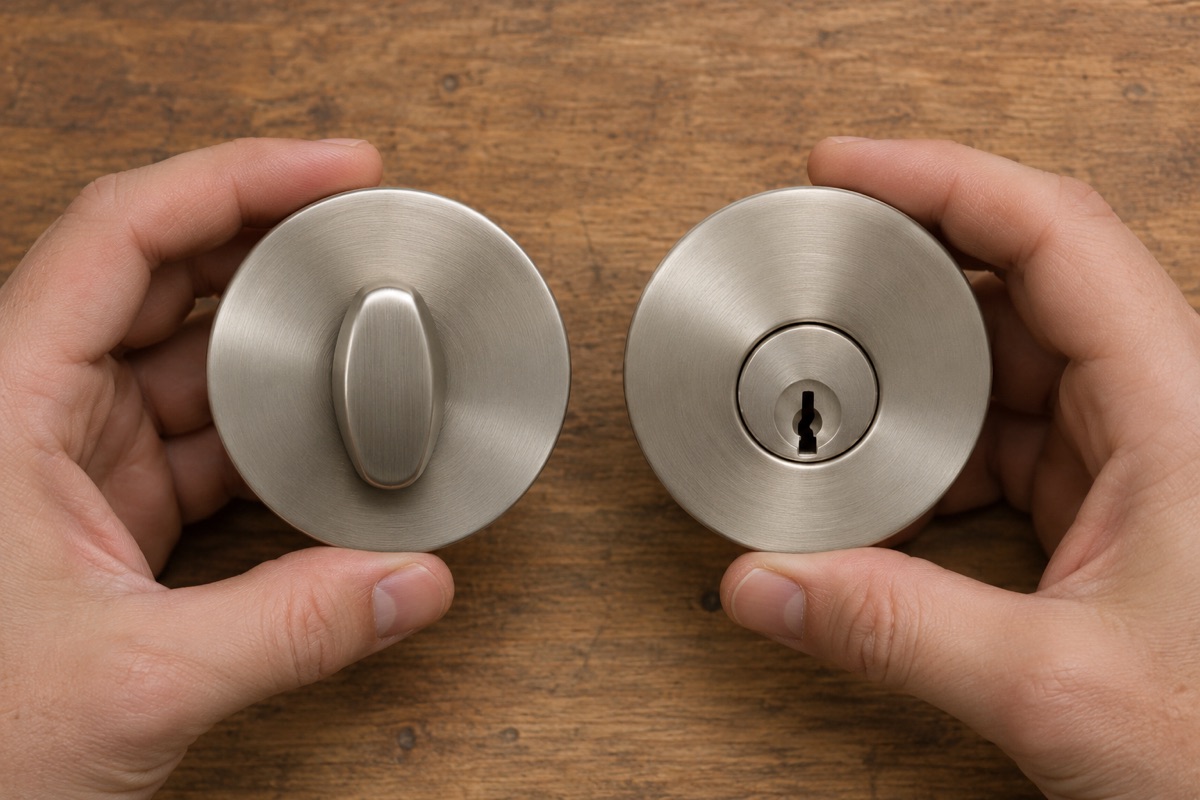
A single cylinder deadbolt uses a key outside and a thumb turn inside. A double cylinder uses a key on both sides, which Kwikset describes as an option for doors near glass or windows. The catch is exit. The model code says the required egress door must open from inside without a key, so a double cylinder on that door deserves a second look.
Here is the plain difference. On a single cylinder, anyone inside can turn the thumb turn and leave. On a double cylinder, someone inside needs a key. On a double cylinder, Kwikset’s install guide says the cylinder with holes should be installed on the interior side of the door.
The egress rule sits in the model code, the International Residential Code. Austin uses the 2024 edition with local amendments, and the city lists it on its building technical codes page. The model code text says egress doors must be readily openable from inside the dwelling without the use of a key or special knowledge or effort.
That sentence is about the required egress door, not every exterior door. It also does not name any hardware type. It just sets the test: can someone get out fast, with no key?
How do deadbolt grades work when you are buying one?
Deadbolt product pages show BHMA grades in two systems: numbers (1, 2, 3) and letters (A, B, C, with AAA shown for security, durability and finish). The residential standard, A156.40, grades each category separately. Read the standard number and the grade together, and compare like with like instead of ranking one label against another.
Product pages really do mix the two. One Schlage page lists a Grade AAA for security, durability and finish and, separately, a Grade 1 under a different standard. A Kwikset page lists Grade 3. Another Kwikset page shows AAA in its description and Grade 2 in its spec list. None of that is a mistake. They are different standards, so the labels do not line up one to one.
What does a grade test? BHMA says its residential deadbolt standard specifies 17 tests. For one related standard on auxiliary locks, BHMA says Grade 1 dead locks face a 1,350 pound force on the door against the bolt. Those are lab tests. BHMA is clear that field results vary with installation and with door and frame construction, so a label is never proof against a kick-in.
So how should you buy? Ask which standard the label names and which grade it shows. Match that to how the door is used. Then weigh it against the estimate, not against a hunch. Our guide to what the high-security label means goes deeper, and our high-security lock installation page covers the service.
Ask for the standard number and the grade together, not just a number. That one habit clears up most of the confusion on a shelf.
What changes the estimate from one Austin door to the next?
Where an estimate lands in the published $120-225 range depends on the door, not on a formula we can run from here. Whether the door is already drilled, how much preparation it needs, whether a strike or reinforcement has to be added, the grade you choose and the hour of the visit can each change where an estimate lands. The technician confirms the number on site.
Each driver ties back to a check you have already read about. A door that is already drilled to the right size needs less preparation than one that needs new bores. A frame that needs a deeper strike hole or a reinforcement takes more work than one that does not. The grade you pick changes the hardware. And service between 10 PM and 7 AM adds the $25 after-hours fee.
Some jobs are not this job at all. A lock change or replacement has its own estimate of $90-200, on our lock change and replacement page. Rekeying is priced per lock, with an estimate of $30-60 per lock, and you can read about it on our residential rekeying page. If you are unsure which of the two you need, start with how to decide between rekeying and replacing.
Smart locks are a separate job with a separate price picture. See our smart lock installation page and our write-up on smart lock installation cost in Austin. Our pricing page lists every published estimate in one place.
What does the Texas Property Code say about deadbolts on rental doors?
Chapter 92 of the Texas Property Code requires a landlord to provide basic security devices on a rental. Section 92.153 lists a doorknob lock or keyed dead bolt on each exterior door. For devices installed on or after September 1, 1993, section 92.154 sets the height between 36 and 48 inches and the bolt throw at not less than one inch, with a strike plate screwed into the doorjamb.
The statute also says a required security device must be installed at the landlord’s expense, and that these rules apply when a tenant is in possession. There are exceptions in other subsections. We are describing the law in general terms, not telling you what applies to your lease.
What should you measure and gather before you call?
Note whether the door is wood, metal or fiberglass, its thickness if you can read it from the edge, any holes already in it, and the brand name on the lock you have now. Then decide whether you want a single or double cylinder and which door it is for. A short list like that keeps the on-site confirmation quick.
That is the whole checklist. Write it on your phone before you call. If a number is missing, say so. The technician can measure the rest on site, and the price is confirmed there, not on the phone.
For what to check before you book any locksmith, see our guide to how to spot a fake locksmith before you book. For the record, Austin Locksmiths holds Texas DPS licence B30821501 and has served Austin since 2015, and you can check the licence yourself.
If you are weighing a bigger upgrade, our guide to signs it is time to upgrade your home security is a soft place to start. When you have your list, call (737) 222-7022 and read it to us.
Frequently asked questions
Can a deadbolt go on a door that has no hole for it?
Yes, when the door can take the two bores. The installer drills the face hole and the edge hole to the sizes on the maker sheet and checks the thickness first. If the dimensions do not fit, the door may need to be modified before the lock goes in.
Does the estimate include the deadbolt itself?
The pricing page notes that the $120-225 estimate includes hardware. It is an estimate, and the technician confirms the exact final price on site before work begins.
Does a new deadbolt come with its own strike plate and screws?
The Schlage parts list includes a strike and a reinforcement plate, and Kwikset’s guide says the longer strike screws install closest to the jamb. Ask which parts come in the box for your model.
What if my door is thicker than the sheet allows?
Kwikset notes a service kit for 2-1/4 inch doors, and other models have their own limits. Check the sheet for the exact model, and expect the technician to confirm what fits on site.
Is there a trip charge?
No trip charge applies. Service between 10 PM and 7 AM adds a $25 after-hours fee, and the final price is confirmed on site before work begins.
Do the makers publish drilling templates?
Kwikset publishes drilling instructions and a printable template that must be printed at 100 percent exact size, and the Schlage sheet points to its own door prep page. A lock fitted off a template is only as good as the measurement behind it.
Next step: get an on-site deadbolt estimate
Note your door’s details, then call (737) 222-7022 or send a request through our contact page. The technician confirms the exact price on site before work begins. You can also read more about our deadbolt installation service first.
Prices shown are estimates
They give you a general idea of what the service costs, and are not a final quote. Your actual price depends on the lock, the vehicle or door, job complexity, and time of day. Your technician confirms the exact final price with you on site, before any work begins.