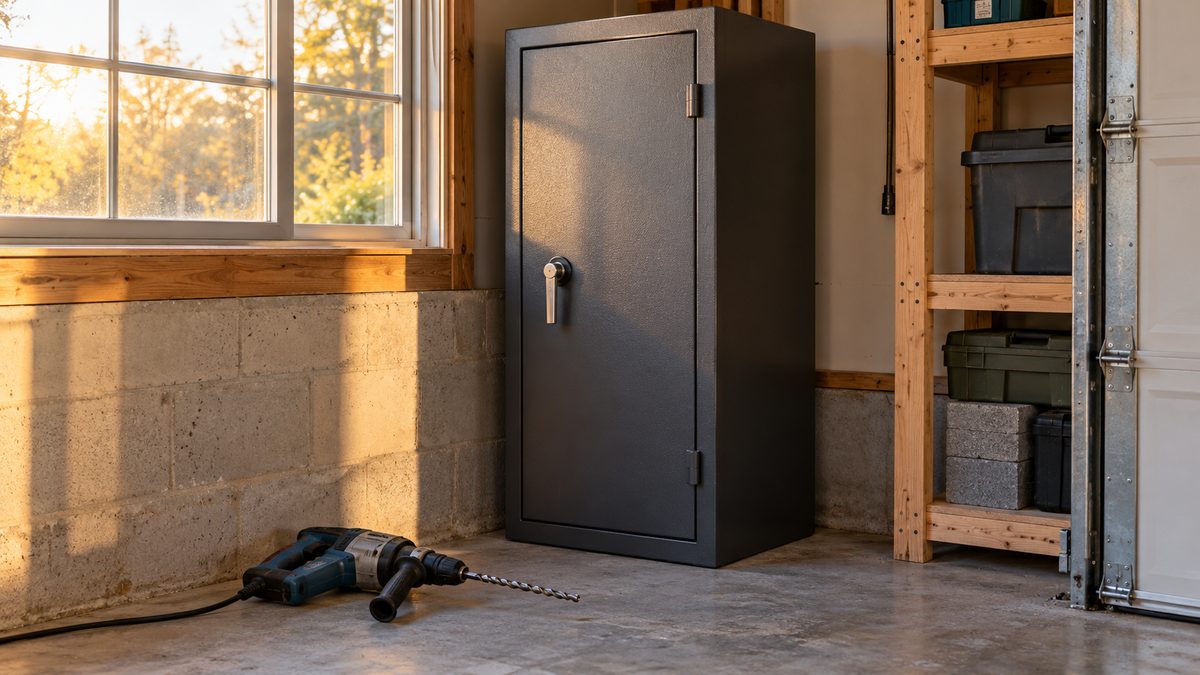

Before a gun safe is bolted down, check five things: what it weighs against the floor under it, what that floor is made of (especially whether a concrete slab is post-tensioned), where it will sit, whether the door can fully open, and how damp the spot gets. Settle those first, and the anchoring itself becomes the easy part.
Austin homes make each of those checks matter. A garage slab in Pflugerville, a bedroom closet in a Westlake-area home and an upstairs room in an older house near downtown are three very different places to put the same safe. This guide walks through the checklist in order, explains what the ratings on the box mean, and says plainly where a professional should take over.
What should you check before a gun safe gets bolted down?
Five checks come before any drill touches the floor: the safe’s weight against the floor under it, the floor type, the exact spot, how far the door swings, and how humid the space gets. Anchoring comes last, once those are settled, because a bolt in the wrong place is hard to undo. The step-by-step anchoring sequence is in the anchoring section below.
Think of it as a planning pass, not a purchase pass. The hard questions tend to arrive on delivery day, when the safe is already in the house and the answers to these five questions are suddenly urgent. Walking the spot with a tape measure and a flashlight beforehand takes a few minutes and removes most of the surprises.
If you want the job done for you, our gun safe installation service covers placement, anchoring and door-swing checks together. For the wider picture of safes we install, see our safe installation overview. And if a safe is only one piece of a larger security upgrade, our guide to the signs it is time to upgrade your home security is a good companion read.
How heavy is the safe, and can your floor carry it?
Weight is the first number to find, because it decides how the safe gets in, where it can go and whether the floor is a question at all. Our service pages use planning bands: small safes under 200 lbs, medium safes from 200 to 500 lbs and large safes from 500 to 1000 lbs. Those are our own planning bands, not maker specifications.
On a ground-level concrete slab, weight is mostly a delivery problem. On an upper floor or a pier-and-beam floor, it is a structural question. One safe maker, Browning, lists “the load your floors and stairs will bear” among the things to consider before a move. We have no sourced floor-load figure to give you, and we would not invent one.
So the honest answer for an upstairs room or a raised wood floor is to ask two people: the safe’s maker, who knows the loaded weight, and a structural professional, who knows your floor. Our home safe installation page explains how we handle medium safes in bedroom closets, which is the most common case.
One boundary to state clearly: we install safes, and we do not move them. The delivery company brings the safe to the room, and we handle the placement and anchoring from there.
Is your floor a concrete slab, wood joists or a post-tensioned slab?
Your floor is one of three things, and each has its own path. A standard concrete slab takes masonry anchors, a wood joist floor takes lag bolts into the framing, and a post-tensioned slab means you stop and confirm what is inside the concrete before anyone drills. If you are unsure which you have, treat it as the third until someone confirms.
A garage floor is concrete, and many ground-floor closets sit on the same slab. Some slabs are post-tensioned, meaning steel cables inside the concrete are held under tension to strengthen it. You cannot see them, which is exactly why the question has to be asked before drilling and not after.
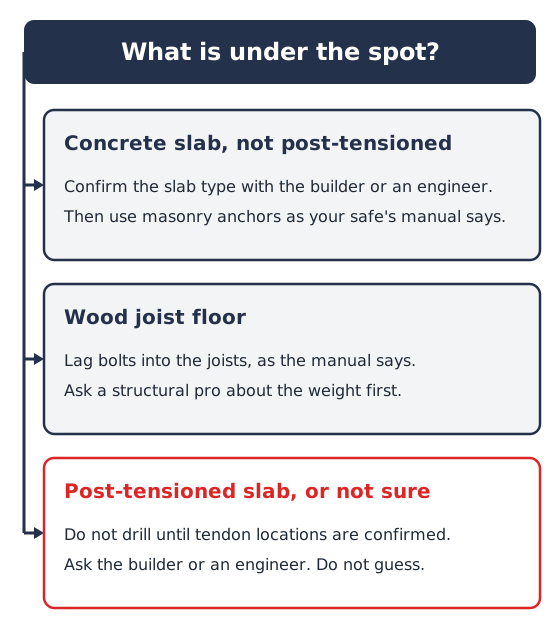
Read the diagram top to bottom. If the floor is a plain slab, you confirm that fact with the builder or an engineer and then follow your safe’s manual. If it is a wood floor, you plan for lag bolts into the joists and ask about weight. If it is a post-tensioned slab or you are not sure, the answer is the same: no drilling until it is confirmed.
How do you know if a slab is post-tensioned before anyone drills?
You find out by asking the people who built the house, and by checking what records exist. The rule is simple: if your slab is post-tensioned, do not drill until the tendon locations are confirmed; ask the builder or an engineer. A guess is not confirmation, and a drill bit that meets a stressed cable can do real damage.
A few things may help you find the answer. A warning stamp may appear on the slab, often near the garage door area. Your builder or a structural engineer may know the design. Building records may also exist, though a tract home’s drawings are not always on file. None of these is proof, and none of them replaces the confirmation step.
We will not give you drilling depths or a do-it-yourself method for locating cables, because that is engineering work and not a weekend step. If your slab is post-tensioned, do not drill until the tendon locations are confirmed; ask the builder or an engineer. When there is real doubt, the safe waits.
How is a safe anchored to a concrete floor?
On concrete, the usual sequence is to set the safe where it will live, mark the floor through the anchor holes in the safe’s base, move the safe aside, drill the marked holes with a masonry bit, then set the safe back and fasten it with expansion anchors and washers. Your own safe’s manual has the final say on size and pattern.
The steps below follow one maker’s published procedure, Browning’s owner manual, as an example of how the job is usually laid out. The four-corner hole pattern in that manual is that maker’s design, not a rule for every safe, so check your manual before you mark anything.
Anchoring a safe to a concrete floor, one maker's example
-
Step 1: Empty the safe
Remove the shelving so you can reach the holes in the safe floor.
-
Step 2: Set it where it will sit
Place the safe in its final spot and remove the hole caps in the base.
-
Step 3: Mark through the holes
Mark the concrete through each anchor hole, then move the safe aside.
-
Step 4: Drill the marks
Use a 3/8 inch masonry bit, with eye, ear and dust protection.
-
Step 5: Set the safe back
Line the base up with the holes you drilled.
-
Step 6: Fasten it down
Install expansion anchors with washers through the safe floor.
Browning’s manual explains the reason for all of this: many common attacks on security safes involve tipping the safe onto its back, and preventing the safe from being tipped or moved reduces the chance of an effective attack. That is the case for anchoring. It is a reason, not a legal rule.
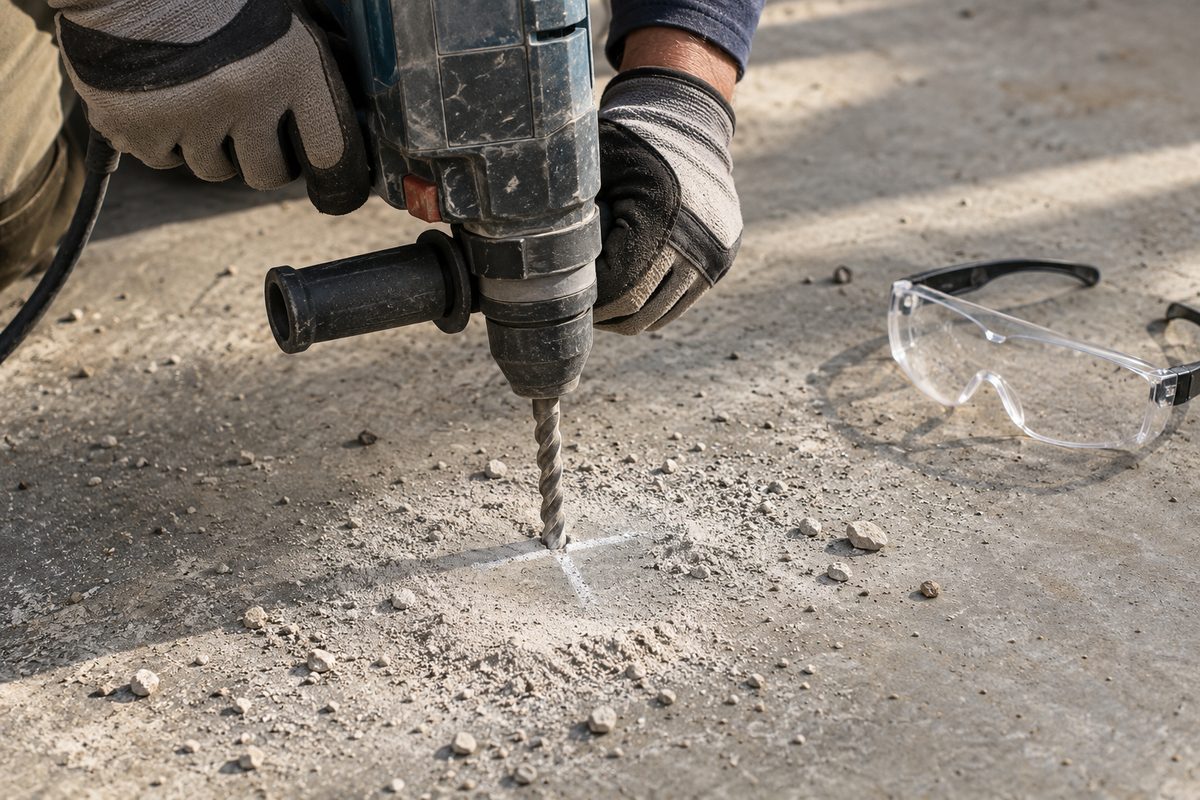
Hard concrete can add time and effort. Our service data notes that very hard, thick or rebar-heavy concrete can add to the cost, which is covered in the cost section below. If you would rather hand the drilling off, our gun safe installation page describes how we handle it.
What changes on a wood floor or in a closet?
A wood floor changes the fasteners, and a closet changes the space. On a wood joist floor, Browning’s manual calls for a 5/16 inch wood bit and lag bolts with washers instead of masonry anchors. In a closet, the main change is room to work: tight walls limit how you drill, level and open the door.
The medium safe in a bedroom closet is the most common installation our service page describes, and in many Austin homes that closet sits on a concrete slab, so the concrete steps above apply. If the closet floor is wood over joists, go back to the weight question near the top of this guide before anything else.
Wood floors also bring a fire-placement question, which we cover in the garage, closet or bedroom section. A safe that is heavy enough to matter can also be heavy enough to be a problem if the framing under it is damaged.
A floor safe is a different job. It is set into the concrete and not bolted on top, so if that is what you are considering, see our floor safe installation page instead of using this checklist.
Garage, closet or bedroom: where should the safe go?
There is no single right room, only tradeoffs. A garage slab is easy to anchor into but has the fire and humidity drawbacks. A bedroom closet is private and close to hand but is often tight. An upper floor adds a weight question. Browning’s manual gives advice you can weigh against your own house, and the table lays it out.
| Location | What works | What to watch |
|---|---|---|
| Garage | Our service data lists a garage with concrete anchoring as a standard install case | Browning advises keeping the safe as far from the garage as possible for fire |
| Bedroom closet | Out of view of windows and away from exterior doors, which Browning recommends | Tight space can limit door swing and drilling room |
| Upper floor | Close to the living space | Browning warns a safe may fall through the floor if fire damages the joist structure |
| Basement | Browning calls a basement against an outside wall the preferred fire position | Basements are uncommon in Austin, so treat this as a principle only |
Whatever room you choose, Browning suggests keeping the safe out of view from windows and normal traffic areas, and away from exterior doors. It also lists the kitchen, furnace and water heater areas and fuel storage as places to avoid for fire reasons.
Those pull in different directions, and that is the point. A garage is convenient to anchor and a poor choice for fire, while a closet is quieter but tighter. Pick the tradeoff you can live with, not the one a headline tells you is correct. You can read more about our approach on the home safe installation page.
Will the door swing fully open, and will the safe fit through the house?
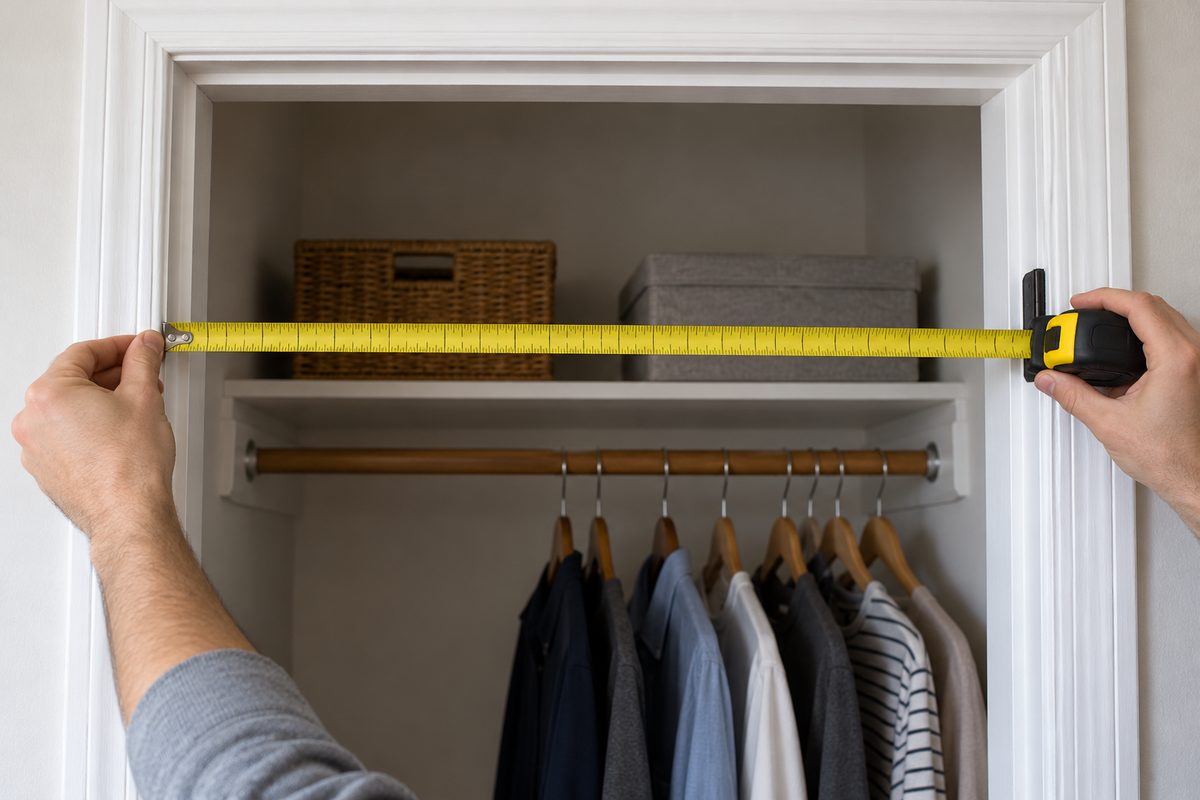
Measure before delivery day: every doorway, hallway turn and stair the safe has to pass, and the space in front of the final spot. Browning notes the door alone can be up to one third of the safe’s total weight, so a door that hits a wall, a vanity or a closet frame limits what the safe can do once it is in place.
Floor type matters here too. Browning’s manual says not to open the safe on an uneven or unstable floor or on plush carpet, because the weight of the open door could cause the safe to tip forward. That is a good reason to settle the floor and the anchoring first.
Some safes have external hinges that let the door open a full 180 degrees and be removed for home installation. If your doorway is tight, ask the maker whether that option exists on your model before you buy or schedule delivery.
Austin heat and humidity: how do you keep the inside dry?
Moisture is the quiet enemy inside a safe. Browning’s manual says condensation can form on firearms and cause rust unless air can circulate, and that the bottom of the safe is lightly finished metal that will rust on a wet floor. Its answer is an electric dehumidifier, which it highly recommends once average daily humidity passes a low threshold.
That threshold is Browning’s own number: above 20 percent average daily relative humidity. It is a maker’s statement, not a standard, and we do not generalize it to every safe. Browning also notes that the safe is not designed for exterior use and warns about moisture damage.
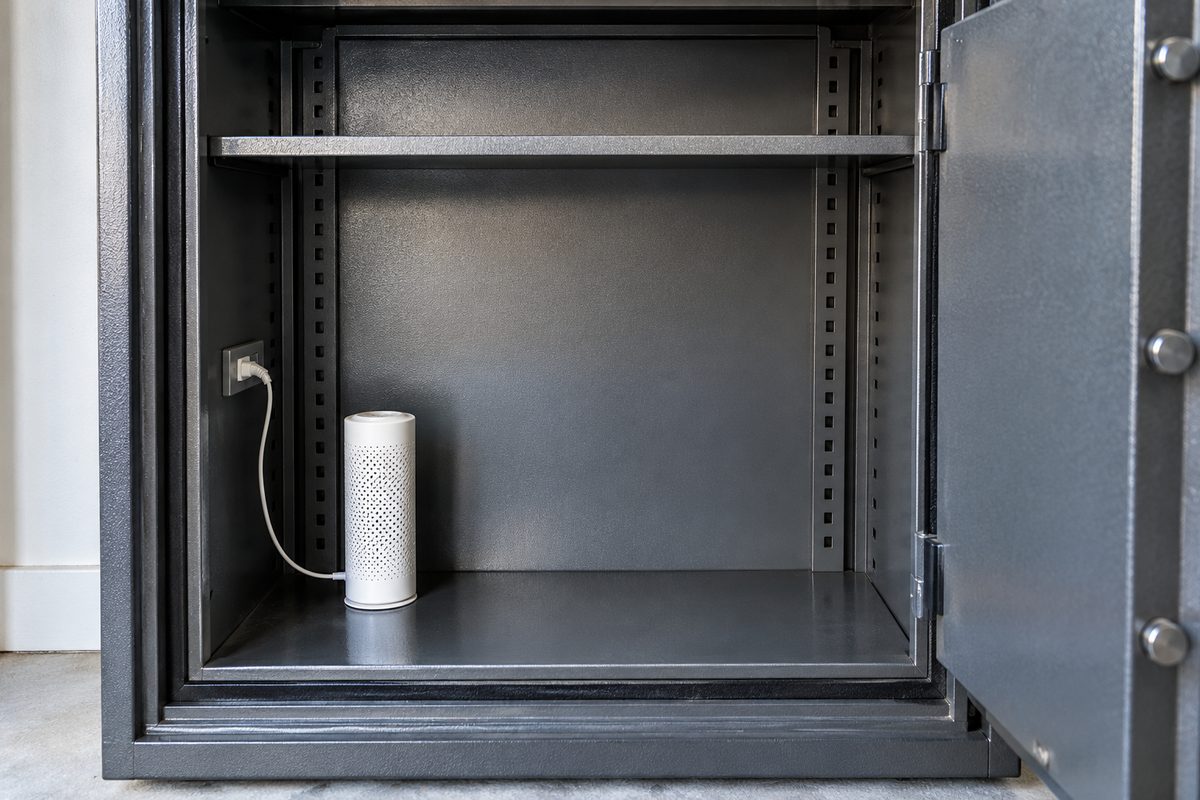
For a safe on carpet, Browning suggests a sheet of clear plastic between the safe and the carpet so the carpet cannot hold moisture against the metal. In a garage or a closet against an exterior wall, that is a cheap thing to think about before the safe goes down.
Some safes have an optional interior outlet for accessories such as a light or a dehumidifier. If you plan to run an electric dehumidifier, ask whether your model has one before delivery.
What do gun safe ratings and fire labels really tell you?
A rating tells you how a safe performed in a defined test, not that it cannot be opened. UL calls Residential Security Containers “commonly known by many as gun safes,” built for security and different from fire resistant containers. Fire and burglary are separate labels, and each has its own test and its own limits.
UL’s description of the revised standard sets three tiers. Level one is a five-minute attack by one technician using common hand tools. Level two is a ten-minute attack by two technicians with more aggressive tools, aiming to create a six square inch opening in the door or front. Level three keeps the ten minutes but shrinks the opening to two square inches.
UL also added a drop test for products weighing 750 pounds or less, simulating an attempt to get in by dropping or knocking the safe over. A product that can be reliably and safely mounted, with installation instructions from the maker, is exempt from that test. Read the full UL notice on the revised standard for the exact wording.
That line is how UL describes a level one test, and it shows what a rating actually measures: time against a specific attacker. Browning’s manual says the same thing in plainer words, that a safe is a deterrent and a delaying device.
None of this means anchoring is necessary to earn a rating, and we would not claim it. For door locks and their own labels, see our separate guide to high-security locks in Austin homes.
What does Texas law say about securing firearms around children?
Texas Penal Code section 46.13 makes it an offense if a child under 17 gains access to a loaded firearm and you, with criminal negligence, either failed to secure it or left it where you knew or should have known the child would gain access. The statute gives a locked container as one example of securing a firearm.
Under the statute, the offense is a Class C misdemeanor, and it becomes a Class A misdemeanor if the child discharges the firearm and causes death or serious bodily injury to anyone. The statute also lists affirmative defenses, including supervised lawful use such as hunting or sporting, and lawful defense of people or property.
We are a locksmith, not a law office. This is a summary of what the text says, not legal advice, and a safe is not a legal safe harbor. The statute lists a locked container as an example of securing a firearm, and nothing more than that.
What does professional safe installation cost in Austin?
What a safe installation costs depends on three things: the safe’s weight, where it sits and the anchoring method. A small safe in a closet is a lighter job than a heavy safe in a garage that needs concrete anchoring, and very hard, thick or rebar-heavy concrete can add time and cost.
Current estimate ranges are on our home safe installation and gun safe installation pages. They are estimates, and the final price is confirmed on site before work starts. They cover installation only, not the safe itself. Smart lock work is a different job with a different price, which our smart lock installation cost guide covers.
Who you hire matters as much as the price. Austin Locksmiths operates under Texas DPS licence B30821501, and you can verify any locksmith’s licence before they work on your home. Our guide to fake locksmith scams in Austin lists the warning signs. To talk through your safe and your floor, call (737) 222-7022.
If you are locked out of a safe you already own, that is a separate service: see gun safe opening and safe combination change.
Frequently asked questions
Do I have to anchor a gun safe?
We found no rule that says you must. Anchoring reduces tip-over attacks, according to Browning’s manual, and it is the sensible default for most homes. Follow your own maker’s manual for the method, and check the floor first.
Can I anchor to a post-tension slab?
Not until you know where the tendons are. If your slab is post-tensioned, do not drill until the tendon locations are confirmed; ask the builder or an engineer. If that confirmation is not available, the safe stays put until it is.
How heavy is too heavy for an upstairs room?
We cannot give you a number, and we would not trust one from a general article. Ask the safe’s maker for the loaded weight and a structural professional for your floor’s capacity before the safe goes anywhere above ground level.
Does a dehumidifier rod really matter?
Browning recommends an electric dehumidifier in humid areas, and warns that condensation causes rust. Whether you need one depends on your safe, the room and your maker’s guidance. In a garage or an exterior-wall closet, it is worth a close look.
Can you move my safe?
No. The delivery company brings the safe into the room, and we install it. If you are still choosing between lock repairs and replacement for other doors, our guide on rekey or replace locks can help.
Next step: check the floor, then call
Start with the five checks above: weight, floor, placement, door swing and humidity. Once those are settled, the anchoring is a short job. If you want help, call Austin Locksmiths at (737) 222-7022, or read about our gun safe installation and home safe installation services first. We can talk through your floor before anyone visits.
Prices shown are estimates
They give you a general idea of what the service costs, and are not a final quote. Your actual price depends on the lock, the vehicle or door, job complexity, and time of day. Your technician confirms the exact final price with you on site, before any work begins.